
informational
Duomo Milan Rooftop Terraces
Updated September 8, 2026
Short answer: the Duomo rooftop is a walkable marble roof on two levels, reached by about 250 steps or by a lift that goes up only. You walk among 135 spires and the flying buttresses, at eye level with statues that are invisible from the square, and you finish under the Madonnina, the gilded copper Virgin at 108.5 metres, placed at the end of 1774. It is the part of the Duomo most visitors say they would pay for again.
What are the Duomo terraces and what do you actually see up there?
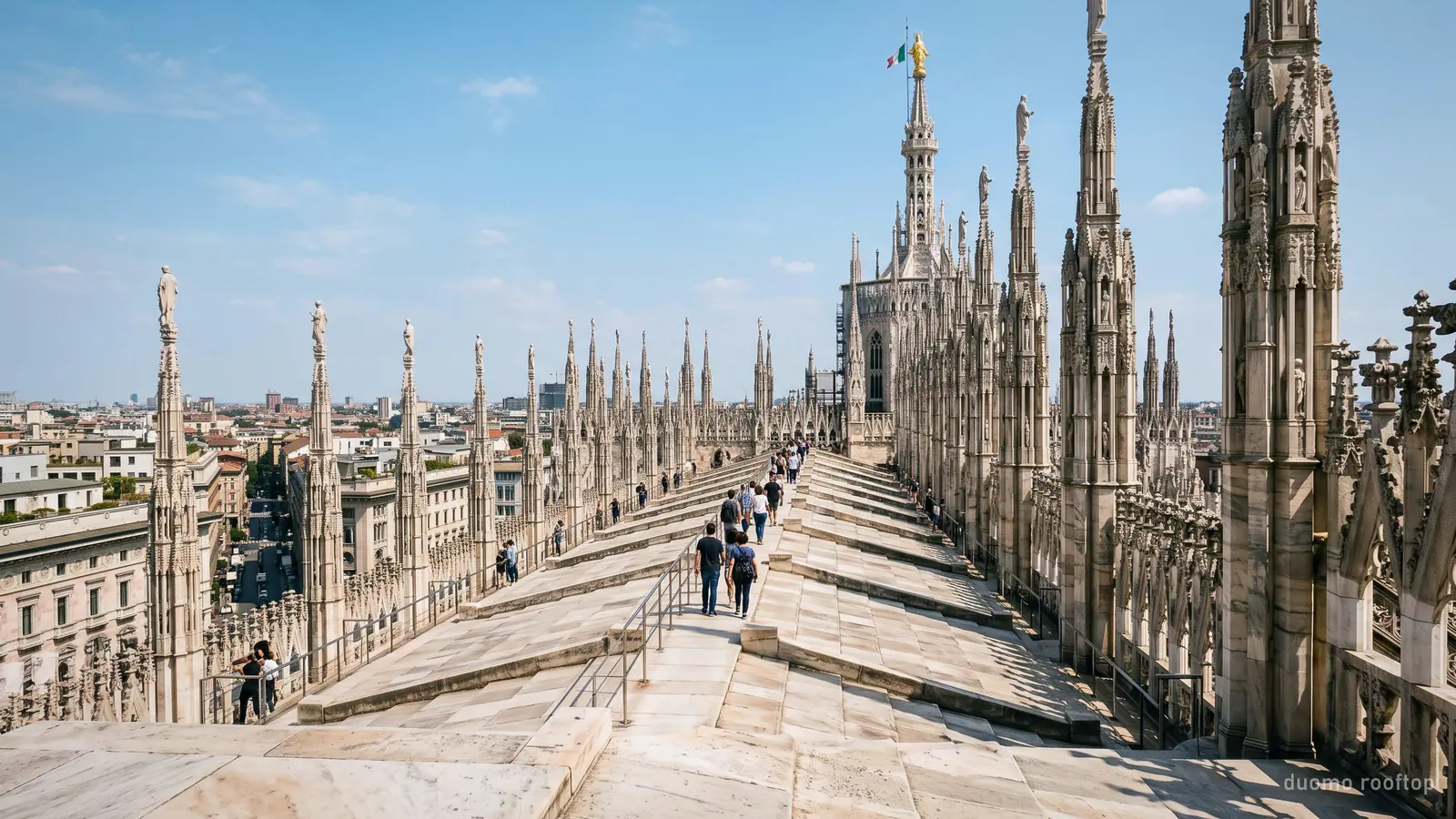
The terraces are the cathedral’s roof, laid as walkable marble slabs and open to visitors on two levels. Above you stand the spires: 135 of them, carrying a statue population the Veneranda Fabbrica counts at roughly 3,400 across the whole building, with about 150 gargoyles draining the roof and 96 giant figures ringing the exterior.
What surprises people is the detail. Candoglia marble from the quarry the cathedral has owned since 1387 comes in pink, grey and white depending on which century repaired that section, and the newer blocks are still visibly paler. Close up you can see chisel marks, tie-rods, drainage channels cut into the slabs, and the numbered replacement statues that come and go between the roof and the Duomo Museum, where the originals are kept out of the weather.
The Main Terrace, the flat area over the crossing, measures about 1,530 square metres, which is why it never feels as tight as the stairways suggest.
How high is the roof and can you see the Alps?
The first walkway level sits roughly 31 metres above the square and the upper terrace at about 45 metres, reached by two steep stairways from the lower level. The Madonnina is far higher again, at 108.5 metres on the main spire, and you look up at her rather than across.
North of the city, on a clear day, the Alps close the horizon. Clarity is a lottery: the Po valley traps haze in summer and fog in winter, and the best odds are the morning after rain, or a cold, windy day in November to February. Closer in, you pick out the Pirellone and the Torre Velasca, the Milano Cortina-era towers of Porta Nuova and CityLife, and directly below, the mosaic floor of the Galleria Vittorio Emanuele II.
By tradition no building in Milan should stand above the Madonnina, and the towers that overtook her carry a small replica so the rule technically holds.
How does the route across the roof work?
The route is one-way and signposted. You arrive on the lower walkway on the north side, follow the buttresses around the apse, cross to the south side and climb to the upper terrace over the nave, then descend into the cathedral through the internal staircase. There is no way back down by lift in normal operation: the lift takes you up, your legs bring you down.
Surfaces are the thing to plan for. The marble is sloped, polished by six centuries of feet, and slick when wet; the stairways are narrow and spiral in places, with no handrail on one side. Flat shoes with grip matter more here than anywhere else in Milan, and a bag you can wear rather than carry makes the stairs easier.
There are no toilets, no café and no shade on the roof. In July and August the marble radiates heat by early afternoon, which is the strongest argument for the first slot of the day.
When is the best time to go up, and are there evening openings?
Go at 09:00 or in the last two hours before the 18:00 last entry. The middle of the day, roughly 10:00 to 14:00, is when coach groups and school trips arrive and when the lift queue is longest; forum reports put that wait at ten to fifteen minutes on an ordinary day and longer on spring weekends.
The Veneranda Fabbrica also runs evening terrace openings. In 2026 the “Serate d’Incanto” ran every Thursday from 11 June to 10 September, opening the terraces from 18:00 with live music among the spires, and the same year brought extraordinary openings to 20:00 on holiday dates. Those sell as separate slots and sell out first; the programme is announced season by season, so check before you build a trip around it.
For light, late afternoon in September gives the warmest colour on the marble. In midwinter the sun is low enough by 16:00 to light the spires from the side, which is the shot most photographers come for.
Is the Duomo rooftop worth it?
For most first visits, yes, and it is the single upgrade worth paying for. The nave is impressive but resembles other great cathedrals; the roof does not resemble anything else, because no other Gothic cathedral lets you walk freely through its spire forest.
Skip it if stairs are a real problem and the lift queue would eat your day, if you are visiting in heavy rain, or if you are travelling with someone uneasy about heights and open edges. The parapets are solid but low by modern standards. In those cases the cathedral, the museum and the archaeological area still make a full visit, and the cathedral and museum ticket costs a good deal less.
If you do go up, decide the stairs-or-lift question before you book, because it changes the ticket and the price.
Frequently asked questions
How many steps to the top of the Duomo?
About 250 to 256 up to the terrace level, in two flights with a landing between them. Visitors who counted on travel forums report figures between 250 and 259, and the lift ticket still leaves you around five steps to climb at the top.
Can you see the Alps from the Duomo roof?
On a clear day, yes: the Alpine wall shows to the north, and the clearest air is usually after rain or on a cold winter morning. Summer haze and the winter fog of the Po valley hide it more often than not.
How long do you need on the terraces?
Allow 45 minutes to walk both levels without hurrying, plus the queue for the stairs or lift. That is on top of 45 to 60 minutes inside the cathedral.
Is the rooftop open in bad weather?
The terraces close in storms and when the marble is icy, and the walkways are unroofed, so rain means a wet visit rather than a cancelled one. Check the official channels on the morning of a stormy day.
Are the terraces the same as the dome?
There is no dome to climb here. Milan Cathedral is roofed by a flat marble terrace system with a central spire, so the walk is along the roof between the spires rather than up inside a cupola as in Florence.
Sources