
informational Pillar guide 9 min read
Inside the Duomo di Milano: What to See
Updated September 8, 2026
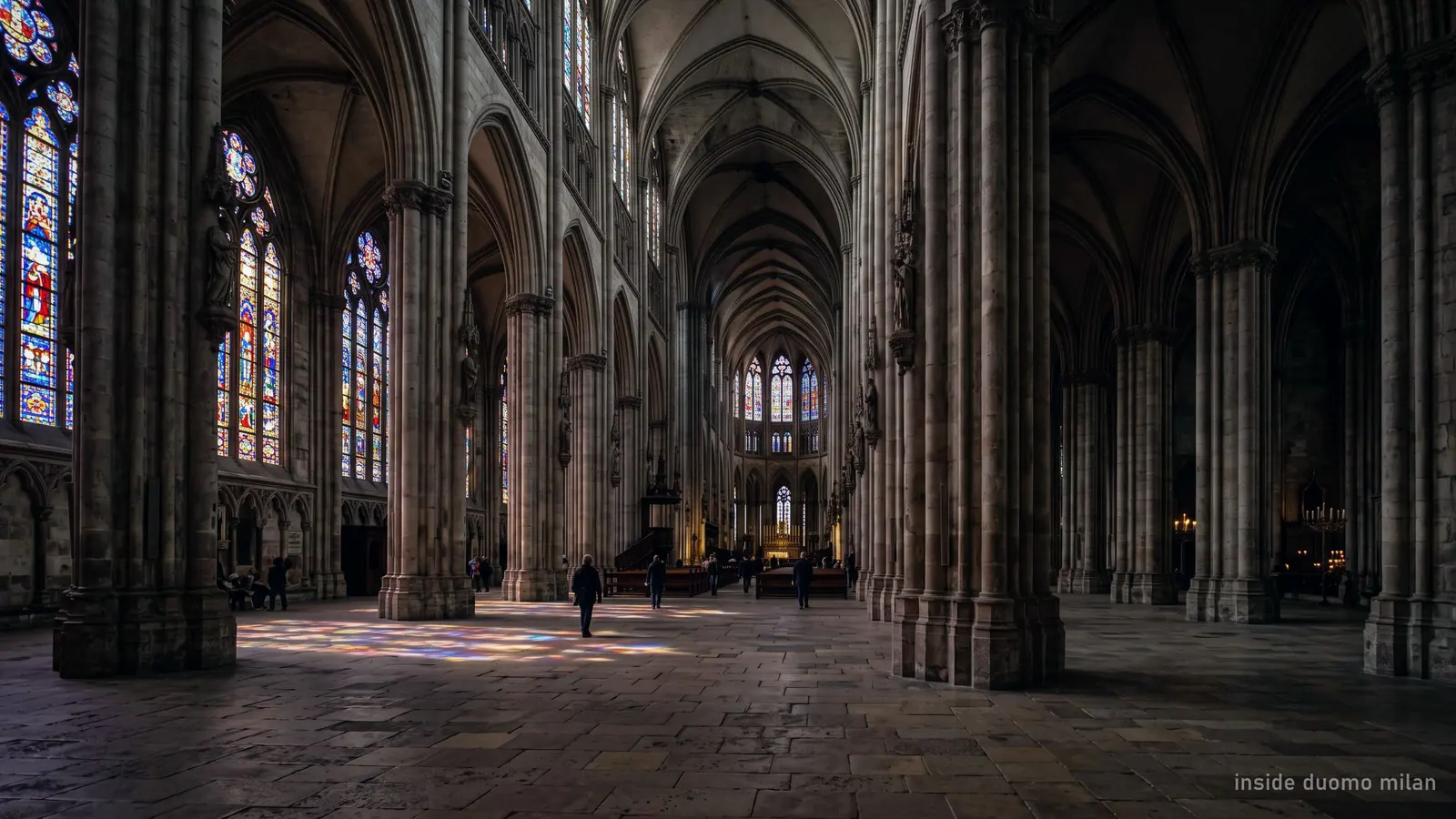
Short answer: inside, the Duomo is a forest. Five naves, 52 pillars, columns 24.5 metres high carrying vaults at about 45 metres, and light that arrives filtered through some of the largest Gothic windows in Italy. Give it 45 to 60 minutes. The things to find are the stained glass in the apse, the flayed Saint Bartholomew, the crypt of Saint Charles, the red light marking the Holy Nail and the brass meridian line in the floor.
What does the inside of the Duomo look like?
Bigger and darker than the photographs. The plan is five naves, unusual in itself, separated by 52 pillars that the guides like to link to the weeks of the year. The columns rise 24.5 metres before the capitals begin, and the capitals are carved with statues rather than foliage, so the eye keeps climbing.
The stone is the same Candoglia marble as the exterior, but indoors it reads grey and cold rather than pink. The floor is a later inlay of black, white and red marbles, laid over centuries and repaired in patches you can see if you look down.
The apse is where the scale lands. Three windows, each about 20.7 by 8.5 metres, throw coloured light the whole length of the choir on a bright morning. Stand at the crossing, look east, and let your eyes adjust for a full minute before you start taking pictures. That minute is the visit.
What are the stained-glass windows?
The glass is a museum of six centuries in one building. The oldest surviving panels date from the 1470s and include work by Cristoforo de’ Mottis and Niccolò da Varallo, and they are the ones worth finding: dense, jewel-like, and much darker than anything around them.
A great deal of the rest was replaced between 1829 and 1858, and the replacements are competent rather than beautiful. The 20th century added more after wartime damage. The result is a single church where you can compare Renaissance glass with 19th-century industrial glass at fifteen paces, which is exactly the comparison the Duomo Museum sets up more comfortably with panels taken down from these windows.
Morning light favours the apse windows; late afternoon favours the south aisle.
What are the main artworks inside?
Three things are worth walking to deliberately.
Saint Bartholomew Flayed, carved by Marco d’Agrate in 1562, stands in the south transept. The saint carries his own skin over his shoulder like a cloak, and the anatomy is displayed with an accuracy that is the point rather than the horror. It is the single most photographed object in the building after the glass.
The Trivulzio Candelabrum, in the north transept, is a seven-branched bronze candelabrum of the 12th century, older than the cathedral itself, crowded with cast figures, animals and monsters at its base.
The monument to Gian Giacomo Medici di Marignano, by Leone Leoni, sits in the south aisle: bronze and coloured marble, a Renaissance tomb inside a Gothic church, commissioned by the Medici brother who became Pope Pius IV.
Behind the choir stands the organ, a five-manual instrument of 225 ranks, the largest in Italy. If you visit near a service you may hear it, which changes the room completely.
Who is buried in the Duomo di Milano?
The crypt below the high altar holds Charles Borromeo, the archbishop who reformed the Milanese church in the 16th century and was canonised in 1610. The scurolo, the small circular chamber where his body lies in a rock-crystal casket, is reached by stairs from the choir and is the quietest place in the building; it is sold separately at €3.50 on the official list and included in some combined tickets.
The cathedral also holds the tomb of Gian Giacomo Medici di Marignano, the graves of a long line of Milanese archbishops, and the memorials of benefactors set into the floors and walls. It is a working cathedral, so treat the crypt as a chapel: no photography during prayer, hats off, and voices down.
What are the Holy Nail and the floor sundial?
Look up above the apse for a small red light. It marks the place where a nail said to come from the Crucifixion is kept, out of reach and out of sight for most of the year. Once a year, at the Rite of the Nivola, the archbishop is raised to it in a cloud-shaped lift built for the purpose, and the relic is brought down and displayed. The word nivola means cloud, and the machine is the reason the ceremony has a name of its own.
Look down, near the north wall, for a brass strip crossing the floor with zodiac markings. This is the meridian line, laid in 1786 by astronomers from Brera. A hole in the roof at about 24 metres lets a disc of sunlight fall on the strip, and the point where it crosses the line marks solar noon. Milan set its clocks by it. On a sunny day around midday you can watch the spot move.
Both are the kind of detail that separates a walk-through from a visit, and neither is signposted well.
How long inside, and what are the photo and dress rules?
Allow 45 to 60 minutes inside, two hours for the cathedral plus the terraces, and about three hours if you are using a combo that includes the museum and the archaeological area. Entry is by timed slot through the security line on the right of the facade, so arrive ten minutes early rather than on the hour.
Cover your shoulders and knees. The rule is applied at the security line, not at the ticket desk, so a valid ticket does not help if you are dressed for the beach; the full conditions are on the dress code page. Hats come off inside. Bags go through a check, and suitcases, glass containers and helmets are refused.
Handheld photography without flash is normally fine; tripods are not, and photography stops when a liturgy begins. Mass is celebrated several times a day and the visitor route pauses around the main services, so if your slot is at 11:00 on a Sunday expect to see the cathedral working rather than empty. That is not a loss. The Duomo follows the Ambrosian Rite, Milan’s own liturgy, with its own calendar and chant, and hearing it is the one thing you cannot get from the roof.
Book a timed cathedral slot before you travel, and pick the hour that suits the light rather than the queue.
Frequently asked questions
How long does it take to see inside the Duomo?
Forty-five to sixty minutes at a normal pace for the nave, the aisles, the apse and the crypt. Add 45 minutes for the terraces and 30 to 45 for the museum if your ticket covers them.
Who is buried in the Duomo di Milano?
Charles Borromeo, the 16th-century archbishop, lies in the crypt below the high altar; the cathedral also holds the tomb of Gian Giacomo Medici di Marignano by Leone Leoni and the graves of many Milanese archbishops.
Can you take photos inside Milan Cathedral?
Handheld photography without flash is normally allowed and tripods are not. Photography stops during Mass, and the crypt and treasury may be signed separately, so read the notice at the door.
Is the inside of the Duomo free?
Only for worship. Worshippers enter free through the northernmost facade door from 08:00 to 19:00 and by the side doors from 07:00 to 08:30, but that route does not give access to the visitor circuit, the terraces or the museum.
How big is the inside of the Duomo?
It is one of the largest churches in the world, with five naves divided by 52 pillars whose columns stand 24.5 metres high and vaults reaching about 45 metres. Estimates of capacity run to around 40,000 people.
Sources