
What are the key facts about the Duomo in Milan?
Updated October 2, 2026
Quick answer
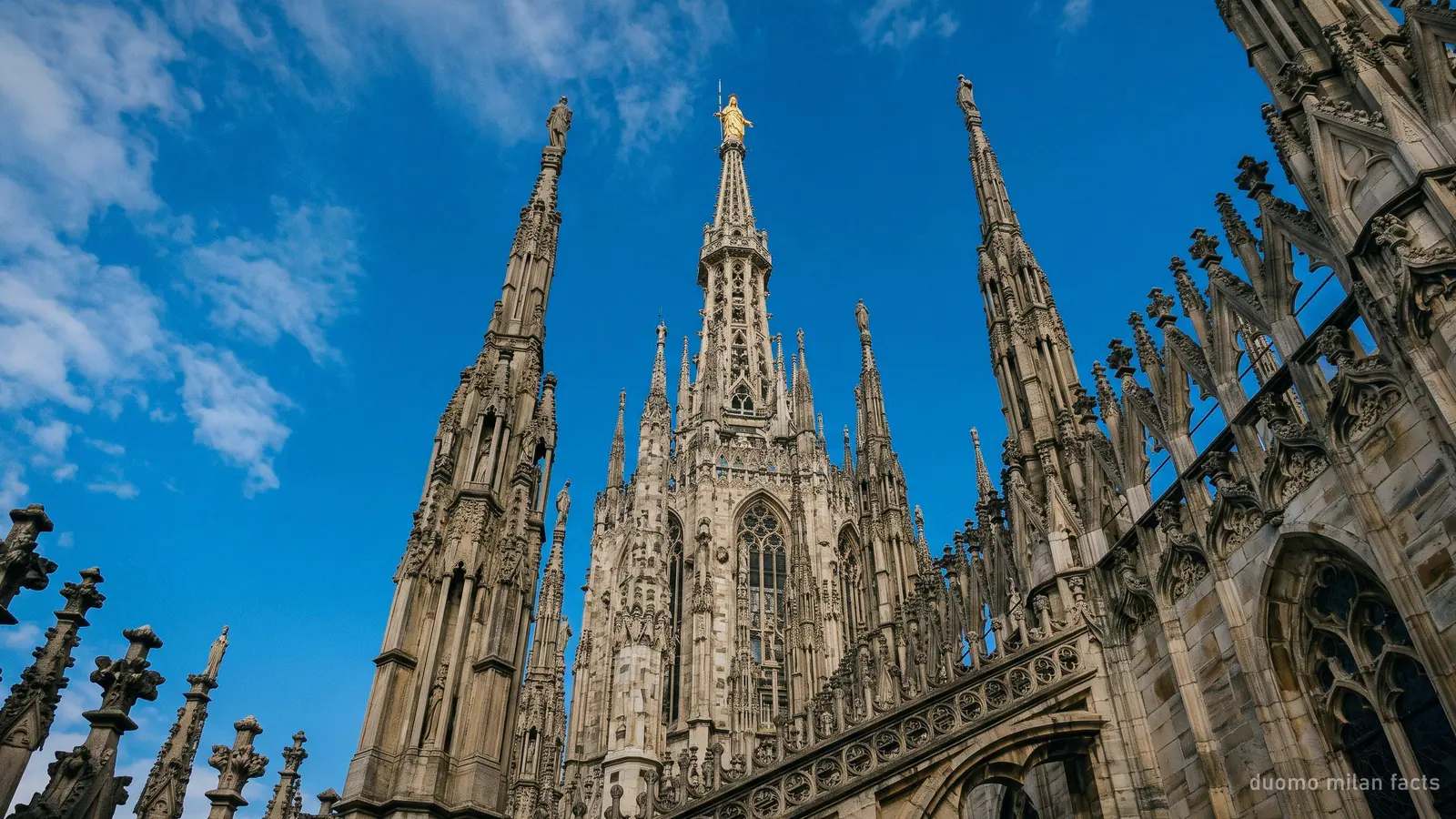
The Duomo di Milano is the cathedral of Milan, begun in 1386 and formally completed in 1965, built of Candoglia marble, carrying 135 spires and about 3,400 statues. By interior area, roughly 11,700 square metres, it is the fifth largest church in the world and the largest in Italy, with room for around 40,000 people. It is Roman Catholic, it is the seat of the Archbishop of Milan, and it follows the Ambrosian Rite rather than the Roman one.
The word duomo comes from the Latin domus, house, in the sense of the house of God, and in Italian it means the main church of a town rather than a dome, which is the confusion most English speakers arrive with. The dome on Florence Cathedral is a cupola; the duomo is the whole building. It is pronounced DWOH-moh, two syllables, with the stress on the first, and Duomo di Milano is DWOH-moh dee mee-LAH-noh. Milan's cathedral is dedicated to Santa Maria Nascente, the Nativity of the Virgin, which is why the Madonnina stands on the highest spire and why 8 September is the building's feast day.
How big is it, and what records does it hold?
About 11,700 square metres of interior floor, which places it fifth among the largest churches in the world after St Peter's in the Vatican, the basilica at Aparecida in Brazil, the Mosque-Cathedral of Córdoba and Seville Cathedral. That makes it the largest church in Italy proper, since St Peter's is in Vatican City. Capacity is usually given as around 40,000. The vaults stand about 45 metres above the floor, carried on 52 pillars whose columns rise 24.5 metres, and the Madonnina tops the main spire at 108.5 metres. It also carries more statues than any other church, roughly 3,400, along with 135 spires, about 150 gargoyles and 96 giant figures on the exterior.
Is it Catholic, and whose seat is it?
Roman Catholic, and the seat of the Archbishop of Milan, one of the largest dioceses in the world. What makes it unusual is the liturgy: Milan follows the Ambrosian Rite, its own tradition named for Saint Ambrose, with a different calendar, different readings and its own chant. Lent starts later than it does in Rome, and the Sunday Mass at 11:00 is celebrated in Ambrosian Latin. The relic of a nail said to come from the Crucifixion is kept high above the apse, marked by a small red light, and brought down once a year in the Rite of the Nivola, when the archbishop is raised to it in a cloud-shaped lift built for the purpose.
Ten facts people actually ask about
One: it took 579 years, from 1386 to the last door on 6 January 1965. Two: the marble comes from one quarry at Candoglia, granted to the cathedral in the 1380s and still owned by it. Three: Napoleon was crowned King of Italy here and ordered the facade finished at French expense, then never paid. Four: a statue of Saint Bartholomew, carved by Marco d'Agrate in 1562, shows the saint carrying his own flayed skin. Five: the brass line in the floor is a working meridian, laid in 1786, that told Milan the time. Six: there is a sundial, a dragon and a zodiac in the building, which is why it attracts symbol-hunting. Seven: the organ has five manuals and 225 ranks, the largest in Italy. Eight: the roof is walkable, which almost no Gothic cathedral allows. Nine: no Milanese building is supposed to rise above the Madonnina, so the taller towers carry replicas. Ten: the Statue of Liberty comparison people repeat, that a Duomo statue inspired it, is a claim this site has not been able to source, and no Veneranda Fabbrica or museum page supports it.
Is the Duomo actually good, or overrated?
The public verdict is unusually strong. On Google the cathedral holds 4.8 out of 5 from about 197,900 reviews, checked in September 2026, which is higher than the Galleria Vittorio Emanuele II next door at 4.7 from about 112,300 and the Sforza Castle at 4.7 from about 89,700. The common complaints in reviews are logistical rather than architectural: queues, the security check, and the discovery that the roof lift only goes up. The common praise is the terraces. Visitors who describe the nave as underwhelming and the roof as unforgettable are the largest single pattern in what people write about it.
Facts for children
Useful ones for a family visit: the cathedral has more statues than any other church in the world, about 3,400, and you can walk on the roof among them. There are stone monsters, the gargoyles, whose mouths are drainpipes. There is a golden lady on the top spire, 108.5 metres up, and a rule that nothing in Milan should be taller. There is a line on the floor that catches a spot of sunlight through a hole in the roof and shows when it is exactly midday. The building took longer to finish than the United States has existed. And the marble arrived by boat, on barges that paid no tolls because they were marked as belonging to the cathedral.
Frequently asked questions
What does duomo mean?
The main church of an Italian town, from the Latin domus, house of God. It does not mean dome, which is a common mix-up in English; Milan's cathedral has spires rather than a cupola.
How do you pronounce Duomo di Milano?
DWOH-moh dee mee-LAH-noh. Duomo is two syllables with the stress on the first, and the uo is a single glide rather than two vowels.
Is the Duomo the biggest cathedral in the world?
No. It is fifth by interior area at about 11,700 square metres, behind St Peter's, Aparecida, Córdoba and Seville, and the largest church in Italy since St Peter's stands in Vatican City.
How many statues does the Duomo have?
About 3,400 across the whole building, more than any other church, plus 135 spires, roughly 150 gargoyles and 96 giant figures on the outside. Weathered originals are replaced and kept in the Duomo Museum.
What is the Duomo called in English?
Milan Cathedral, or the Cathedral of the Nativity of Saint Mary, from its dedication to Santa Maria Nascente. Italians call it simply il Duomo.
How old is the Duomo di Milano?
Begun in 1386 and formally completed on 6 January 1965, on a site where Milan's cathedrals have stood since the fourth century; the baptistery under the square dates to about 378.
Is Milan Cathedral a UNESCO World Heritage Site?
No. The Duomo is not on the UNESCO World Heritage List or on Italy's Tentative List. Milan's World Heritage Site is the Church and Dominican Convent of Santa Maria delle Grazie with Leonardo da Vinci's Last Supper, inscribed in 1980 and about 1.5 km from the cathedral.
Sources