
informational 8 min read
History of the Duomo di Milano
Updated September 8, 2026
Short answer: the first stone was laid in 1386 and the last door was inaugurated on 6 January 1965, which makes the Duomo a 579-year building project. It was begun by Archbishop Antonio da Saluzzo under Gian Galeazzo Visconti, paid for by a marble quarry and a tax exemption, run throughout by one institution, and finished only because Napoleon wanted a facade for his coronation.
When was the Duomo di Milano built?
In 1386, on the site of two earlier churches. Beneath the present cathedral lie the remains of the basilica of Santa Tecla and the Baptistery of San Giovanni alle Fonti, built about 378, where Ambrose baptised Augustine in 387. Milan had been a Christian capital for a thousand years before the Gothic project began.
What went up in 1386 was meant to be a Lombard Gothic brick church, planned by the chief engineer Simone da Orsenigo with a workforce of around 300. It did not stay brick, and it did not stay Lombard. Within a few years the design had turned towards the northern European Gothic that gives the building its unusual look in an Italian city, and towards marble, because marble had suddenly become free.
Who built it, and how was it paid for?
Two decisions made the cathedral possible, and both belong to Gian Galeazzo Visconti. He granted the Fabbrica exclusive access to the Candoglia marble quarries on Lake Maggiore, and he exempted the project from taxes. A material that would have been ruinous became the standard building stone, floated down the lake and the canals to the site.
The second decision was institutional. The Veneranda Fabbrica del Duomo was created to run the work, and it still does: it owns the quarry, employs the carvers, maintains the roof and sells the tickets. Nearly every other great European cathedral changed hands, changed purpose or lost its building fund. This one kept the same organisation for six hundred and forty years, which is why the repairs match the original and why the marble on the roof today comes from the same hillside.
The phrase fabbrica del duomo passed into Milanese dialect as an expression for a job that never ends.
Why did it take nearly six centuries?
Money, war and indecision, in that order.
The design was argued over from the start. Foreign masters were called in from France and Germany, disagreed with the Lombard builders about proportion and structure, and left. Expert panels were convened repeatedly across the 15th century to settle questions that a single architect would have decided in an afternoon. The wooden model kept in the Duomo Museum is a physical record of those arguments.
Then Milan changed rulers: Visconti, Sforza, French, Spanish, Austrian, French again, Austrian again, Italian. Each change interrupted the funding. Leonardo da Vinci submitted a design for the crossing tower in the 1480s and it was not adopted. The nave was finished, the transepts followed, the apse windows were glazed, and the facade stayed a brick wall with a temporary front for two hundred years.
What happened under Napoleon, and when did the Madonnina go up?
On 20 May 1805 Napoleon Bonaparte, about to be crowned King of Italy in the cathedral, ordered the facade to be completed and told Pellicani that the French treasury would pay. The work was done; the treasury never reimbursed it. It is the single most effective intervention in the building’s history, and it happened because a coronation needed a backdrop.
The Madonnina came earlier. The gilded copper Virgin, sculpted by Giuseppe Perego, stands on the main spire at 108.5 metres, and the Veneranda Fabbrica’s own account puts her in place at the end of 1774, crowning a Main Spire built between 1765 and 1770 under the architect Francesco Croce. Milanese custom holds that nothing in the city should stand above her, and the towers that now do carry small replicas so the custom survives the skyline.
The late 18th century brought the meridian line of 1786 in the floor, laid by the astronomers of Brera, and the 19th the wholesale replacement of the stained glass between 1829 and 1858.
What did the war do to it, and when was it finished?
Allied bombing damaged the cathedral in 1943, less badly than the buildings around it, and it was patched quickly enough to serve as shelter for Milanese whose homes were gone. The refectory of Santa Maria delle Grazie, a mile away, was destroyed in the same raid of 15 August 1943, and Leonardo’s Last Supper survived only because the wall had been sandbagged.
The formal end came on 6 January 1965, when the last of the bronze doors was inaugurated. It is a strange completion date for a medieval building, and it is the honest one.
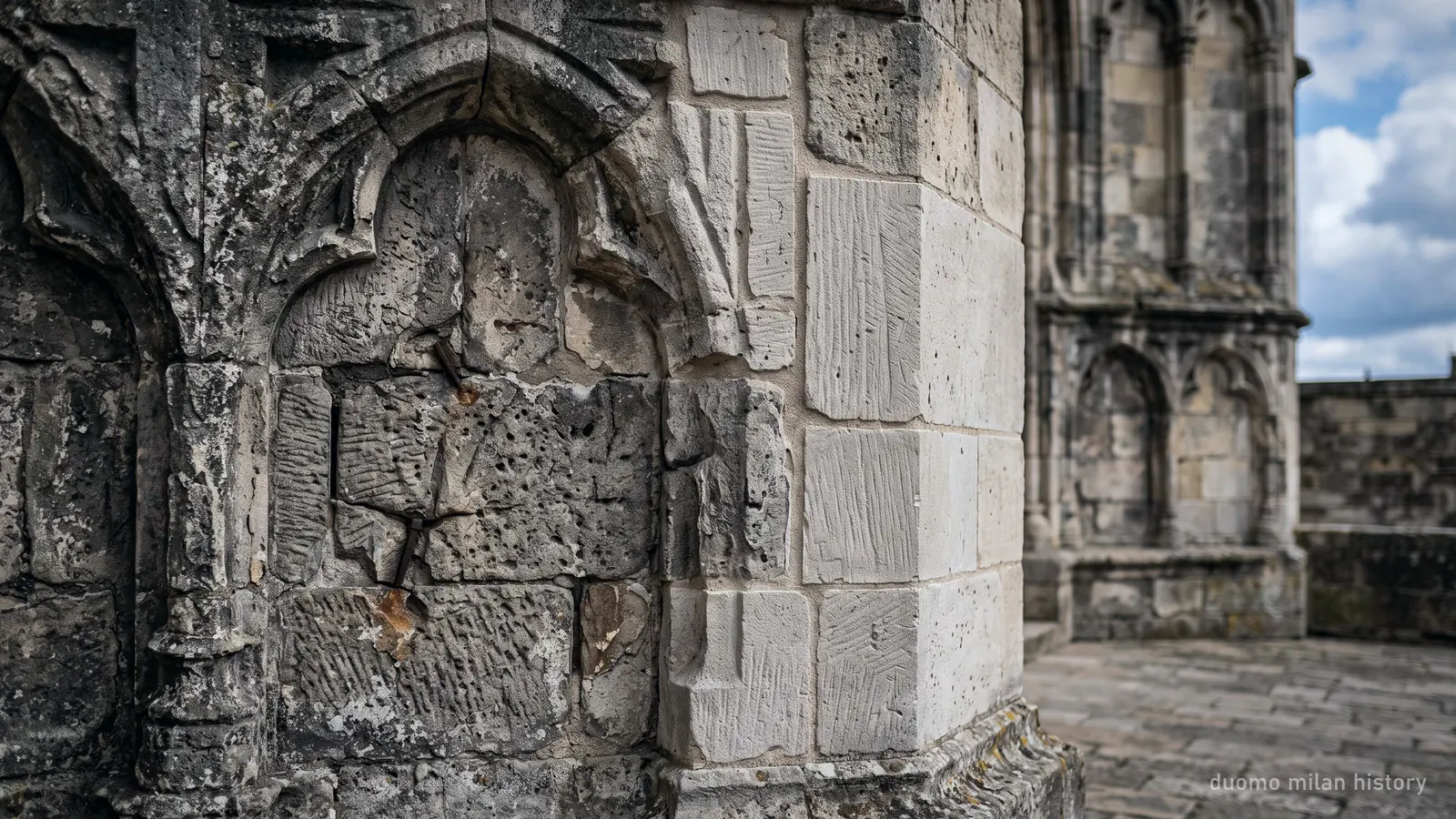
Nothing has stopped since. Statues come down when the weather has finished with them, go into the Duomo Museum, and copies go up in their place; the quarry still supplies the stone. If you walk the terraces you can read the whole chronology in the colour of the blocks, which is the argument for buying a ticket that includes the roof rather than the nave alone.
Frequently asked questions
How old is the Duomo in Milan?
Construction began in 1386, so the building is well over six hundred years old, but the last door was only inaugurated on 6 January 1965. Both dates are true, which is why answers to this question disagree.
Who built the Milan Cathedral?
Archbishop Antonio da Saluzzo began it in 1386 with the backing of Gian Galeazzo Visconti, and the Veneranda Fabbrica del Duomo has run the work ever since. No single architect designed it; dozens did, across six centuries.
How long did it take to build the Duomo di Milano?
579 years from the first stone in 1386 to the last door in 1965, though the cathedral was consecrated and in use for most of that time. Maintenance has never stopped, so in a real sense the work continues.
Why is the Duomo made of pink marble?
Because Gian Galeazzo Visconti granted the Fabbrica exclusive use of the Candoglia quarry on Lake Maggiore, and Candoglia marble has a pink-grey cast. The grant is why a marble cathedral was affordable at all.
Was the Duomo damaged in the Second World War?
Yes, in the Allied bombing of Milan, though less severely than neighbouring buildings, and it was repaired quickly enough to shelter people whose homes had gone.
Sources