
informational 8 min read
Duomo Milan Architecture: Spires and Glass
Updated September 8, 2026
Short answer: the Duomo is Gothic in ambition, Lombard in construction and layered with everything that happened afterwards. Its identity comes from three things: Candoglia marble, a roofline of 135 spires carrying about 3,400 statues, and a five-nave interior on 52 pillars whose columns rise 24.5 metres before the arches begin.
What architectural style is the Duomo di Milano?
Gothic, with arguments attached. The 1386 project began as Lombard Gothic in brick, then shifted towards the pointed, vertical northern Gothic of France and Germany when foreign masters were consulted. Those masters and the local builders disagreed about proportion and structure for most of a century, and the building carries both traditions.
Then time added layers. The facade, forced to completion under Napoleon in the early 19th century, sets Gothic tracery above classical portals and pediments, a combination no medieval architect would have drawn. The stained glass mixes 15th-century panels with 19th-century industrial glazing. The result is not a pure example of anything, which is exactly what makes it unlike the cathedrals it was competing with.
Seen from the square it reads as one design. Seen from the roof, where you are close enough to date the stonework, it reads as six centuries of committee.
Why is it built of Candoglia marble?
Because Gian Galeazzo Visconti gave the Veneranda Fabbrica exclusive use of the Candoglia quarry on Lake Maggiore, and exempted the work from tax. That grant turned an impossible material into the default one, and the Fabbrica still owns the quarry today.
Candoglia marble has a pink-grey cast that changes with the light and the century. Blocks cut recently are paler than the weathered ones beside them, so a facade that looks uniform in photographs is visibly patchworked in person. The stone travelled by water, down the lake and along the canal system into the middle of Milan, on barges marked AUF, for ad usum fabricae, exempt from tolls.
The material also explains the maintenance. Marble erodes; statues are replaced; the originals go to the Duomo Museum. The building is less a finished object than a process with a quarry attached.
What is on the roofline: spires, statues, gargoyles?
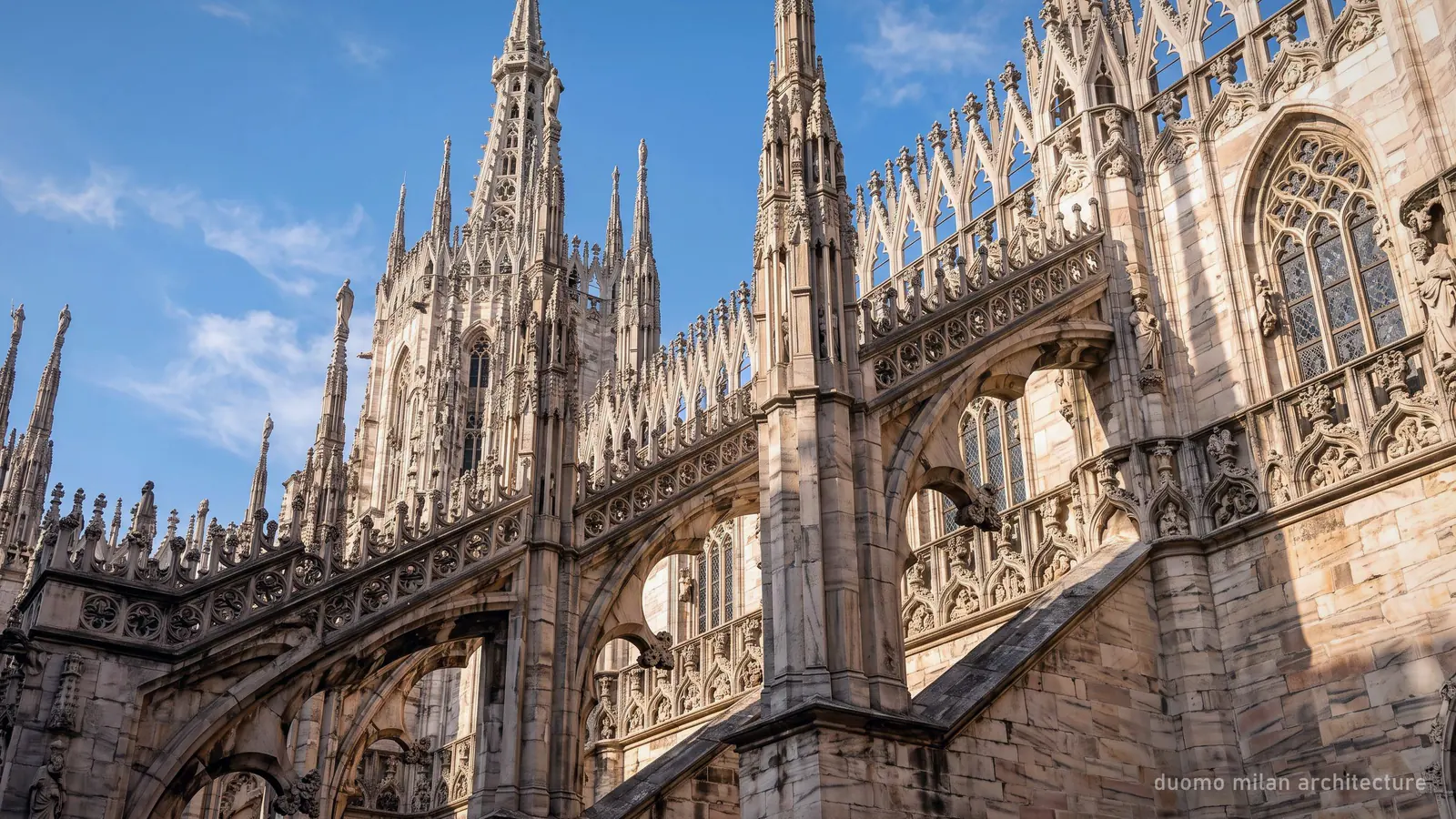
The roofline is the reason to buy the terrace ticket. There are 135 spires, each carrying a statue at its tip, around 150 gargoyles draining water clear of the marble, and 96 giant figures ringing the exterior. The Fabbrica’s count of statues across the whole building runs to about 3,400, more than any other church.
Structurally, the roof is not a roof in the northern sense. Instead of a steep pitched covering, the Duomo carries a system of flat marble slabs with drainage channels cut into them, which is why visitors can walk it. Flying buttresses take the thrust of the vaults outwards, and the forest of spires both weights and decorates them.
Above everything stands the Madonnina, gilded copper on the main spire at 108.5 metres, sculpted by Giuseppe Perego and placed at the end of 1774, on a Main Spire built between 1765 and 1770 under Francesco Croce.
What are the five bronze doors?
The facade has five bronze doors, and they are the newest major element of the building. They were cast across the 20th century by different sculptors, with the central door, the largest, by Ludovico Pogliaghi. The last of the five was inaugurated on 6 January 1965, the date usually given for the cathedral’s completion.
They are worth two minutes before you go in. The panels are narrative relief, telling the life of the Virgin, the history of Milan, the story of Saint Ambrose and the edict of Constantine, and the surfaces are polished bright where six decades of hands have touched the same figures. That wear is the most human thing on the exterior.
What is the interior plan?
Five naves, separated by 52 pillars, with columns 24.5 metres high whose capitals carry statues where foliage would normally go. The vaults reach about 45 metres. The apse holds three windows about 20.7 by 8.5 metres, among the largest Gothic windows anywhere, and their tracery is the finest stonework in the building.
The five-nave plan is unusual and it is what makes the interior feel like a forest rather than a hall: sightlines are broken, the far walls are invisible from most positions, and the scale reveals itself slowly. Capacity estimates run to around 40,000 people, and by interior area, about 11,700 square metres, the Duomo ranks fifth among the largest churches in the world, after St Peter’s, Aparecida, the Mosque-Cathedral of Córdoba and Seville.
Set into that plan are the brass meridian line of 1786, the crypt of Saint Charles beneath the high altar, and an organ of five manuals and 225 ranks, the largest in Italy.
Who were the architects?
Everyone and no one. Simone da Orsenigo drew the first scheme in 1386. French and German masters were summoned and dismissed. Expert commissions across the 15th century decided the proportions by vote. Leonardo da Vinci submitted a design for the crossing tower and lost. Pellicani finished the facade on Napoleon’s order in 1805, and 20th-century sculptors closed the building with its doors.
The continuity was institutional rather than personal: one body, the Veneranda Fabbrica, holding the drawings, the quarry and the craft. If you want to see the design argument itself rather than its result, the wooden models and the original statues in the Duomo Museum are where it is kept, and the terrace ticket is where you get close enough to the marble to see who won.
Frequently asked questions
What style is the Duomo di Milano?
Gothic, but an Italian Gothic that absorbed northern European ideas and then took on Renaissance and Neoclassical layers as the work dragged on. The facade in particular mixes Gothic tracery with classical portals.
How many statues are on the Duomo?
Around 3,400 across the building, together with 135 spires, roughly 150 gargoyles and 96 giant figures on the exterior. The originals come down as they weather and are kept in the Duomo Museum.
What are the Duomo's doors made of?
Bronze. There are five on the facade, cast between 1906 and 1965 by different sculptors, with the central one by Ludovico Pogliaghi. The last of them was inaugurated on 6 January 1965.
Is the Duomo the largest Gothic cathedral?
It is one of the largest churches in the world, fifth by interior area at about 11,700 square metres, and the largest church in Italy after St Peter's, which is in Vatican City rather than Italy.
Who designed the Duomo di Milano?
No one person. Simone da Orsenigo drew the first plan in 1386, expert panels from France and Germany argued over it for a century, Pellicani finished the facade under Napoleon, and the Veneranda Fabbrica has directed the work throughout.
Sources