
informational 7 min read
Duomo Milan Photo Spots
Updated September 8, 2026
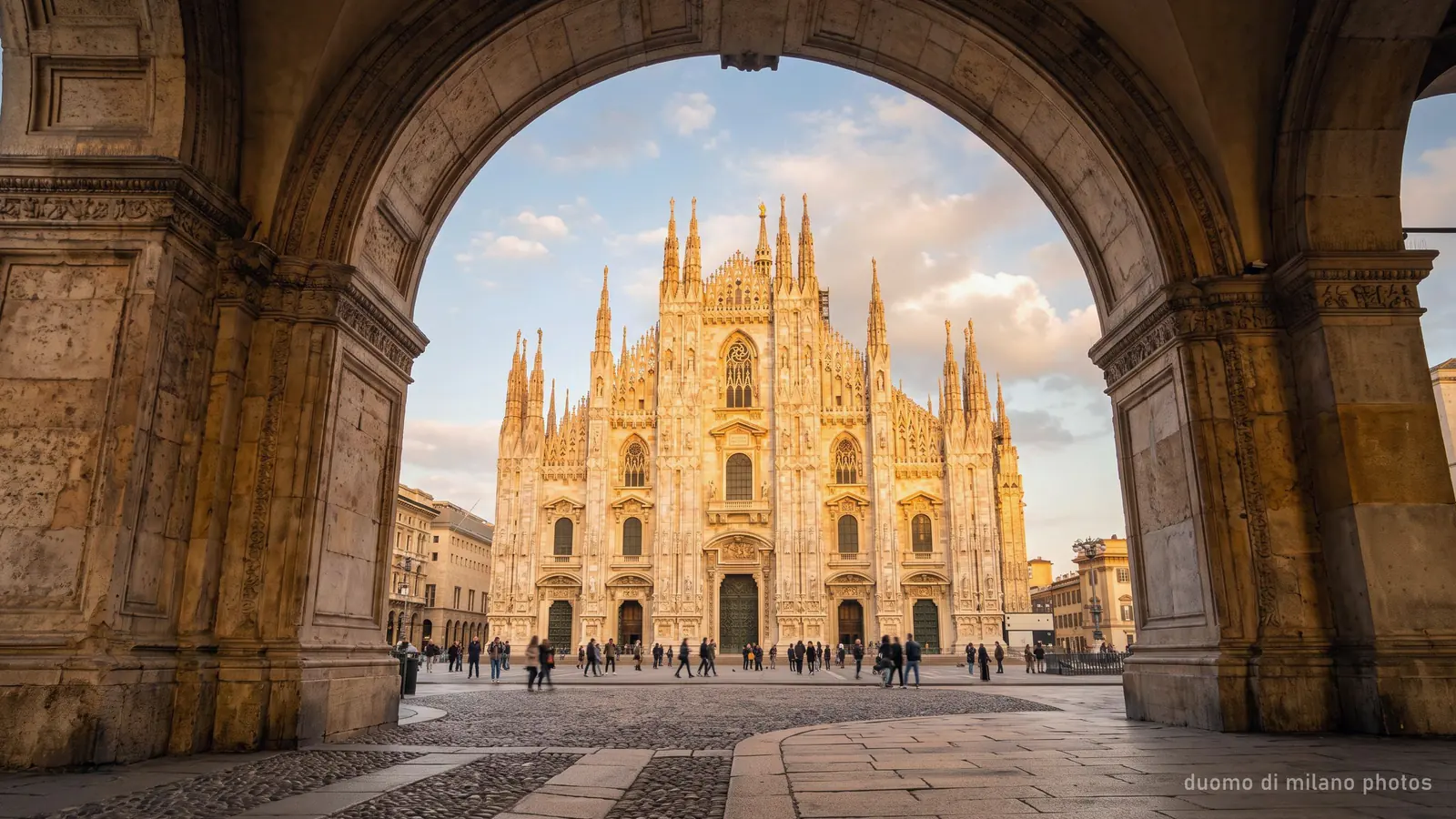
Short answer: four positions do most of the work. The centre of the square for the whole facade, the north arcades for a framed foreground, the Galleria’s octagon looking out through the arch, and the terraces themselves for the spires. Add the Museo del Novecento window for the one elevated angle that costs a museum ticket rather than a cocktail.
Where are the best photo spots on the piazza?
Start at the equestrian monument to Victor Emmanuel II, inaugurated in 1896, in the middle of the square. It is far enough back that the facade fits without extreme distortion, and the statue gives you a foreground that stops the picture being a flat elevation.
Move to the arcades on the north and south sides, the Palazzi dei Portici completed in 1875. Shooting out from under the columns puts a dark frame around a bright building, which is the single easiest way to make a phone photograph look composed.
Then walk to the far corners. From the south-east, near the Palazzo Reale, you get the flank of the building with the buttresses in perspective rather than the facade head-on, and far fewer people in the frame. The square covers about 17,000 square metres, so a hundred metres of walking changes the picture completely.
Pigeons, sellers and the crowd are part of the square. Shoot them deliberately or shoot early, because there is no hour when the piazza is empty.
What are the best angles on the roof?
On the terraces, stop photographing the view and photograph the building. The view over Milan is wide and flat and rarely holds up; the spires are what nothing else looks like.
Three positions repay attention. The lower walkway on the north side, where the flying buttresses line up in a receding row. The upper terrace over the nave, where the main spire and the Madonnina stand against the sky at 108.5 metres and the surrounding statues give scale. And the apse end, where the crowd thins because most people have already turned back.
Close in, the gargoyles and the 96 giant figures are the shots people remember, and a short telephoto gets them cleanly. The marble is bright, so expose for the stone and let the sky go where it goes; the roof is unshaded and midday light flattens everything.
Which elevated viewpoints work, and what do they cost?
The Museo del Novecento in the Palazzo dell’Arengario, which opened on 6 December 2010, has a top-floor restaurant-bar overlooking Piazza del Duomo and a window that frames the facade almost dead-on. It is the best elevated angle in the city and it comes with a museum full of Boccioni and Fontana attached.
The department store on the square has a top-floor food hall and terrace facing the cathedral, added in 2007, where the angle is close and high. The two commercial terraces on and beside the square trade on the same view: one in the Galleria, rated 3.6 from 5,810 Google reviews, and one at Piazza del Duomo 21, rated 3.3 from 3,505, both scored well below the monument itself, which holds 4.8 from about 197,900. Read that as a warning about the drinks, not about the view.
What may you photograph inside?
Handheld, without flash, almost everything: the five naves, the 52 pillars, the apse windows, the statue of Saint Bartholomew Flayed carved by Marco d’Agrate in 1562, the meridian line of 1786 in the floor. Tripods are not permitted, and photography stops when a liturgy begins.
The interior is much darker than it looks. Braced against a pillar at a slow shutter speed will beat pushing the sensitivity, and the coloured light from the apse at mid-morning is the one condition worth waiting for. The crypt of Saint Charles is a chapel with a body in it; treat it as such and put the camera away.
What is the best light, hour by hour?
Sunrise gives an empty square and a facade in flat shadow, good for the building’s geometry and useless for its colour. From mid-morning the sun comes round to light the front directly, which is the postcard and the harshest version.
Late afternoon is the hour to book a terrace slot. The marble turns warm, the spires cast long shadows across the roof, and in September the light lands at exactly the right angle on the west front. In December and January the sun sets before the 18:00 last entry, so a standard ticket buys you golden hour on the roof, which no other month allows.
Blue hour, the twenty minutes after sunset, is the strongest light on the square: the floodlights come up while there is still colour in the sky, and the balance between the two is what makes the picture. After that it is night photography, best from under the arcades or inside the Galleria’s octagon, where the glass roof and the mosaic floor take the light. Book a late terrace slot in winter or an evening opening in summer, and you get both halves of the day in one visit.
Frequently asked questions
Can you take photos inside Milan Cathedral?
Handheld photography without flash is normally allowed; tripods are not, and photography stops during Mass. Read the notice at the entrance, because rules for the crypt and treasury can differ.
Where is the best view of the Duomo for photos?
For the whole facade, the centre of the square by the Victor Emmanuel II monument. For a framed shot, under the north arcades or through the Galleria arch. For an elevated angle, the Museo del Novecento window or a rooftop bar.
Can you use a drone over the Duomo?
No. The square and the cathedral are not a place to fly one, and the airspace over central Milan is restricted, and ENAC rules apply.
What lens do you need?
Something wide, around 16 to 24 mm on full frame, for the facade and the roof walkways, plus a short telephoto for the statues and gargoyles you cannot get close to. A phone ultra-wide covers most of it.
Is a tripod allowed on the piazza?
On the open square, yes in practice, and it is the only way to work after dark. Inside the cathedral and on the terraces, no.
Sources