
Piazza del Duomo Milan: What to See in the Square
Updated September 8, 2026
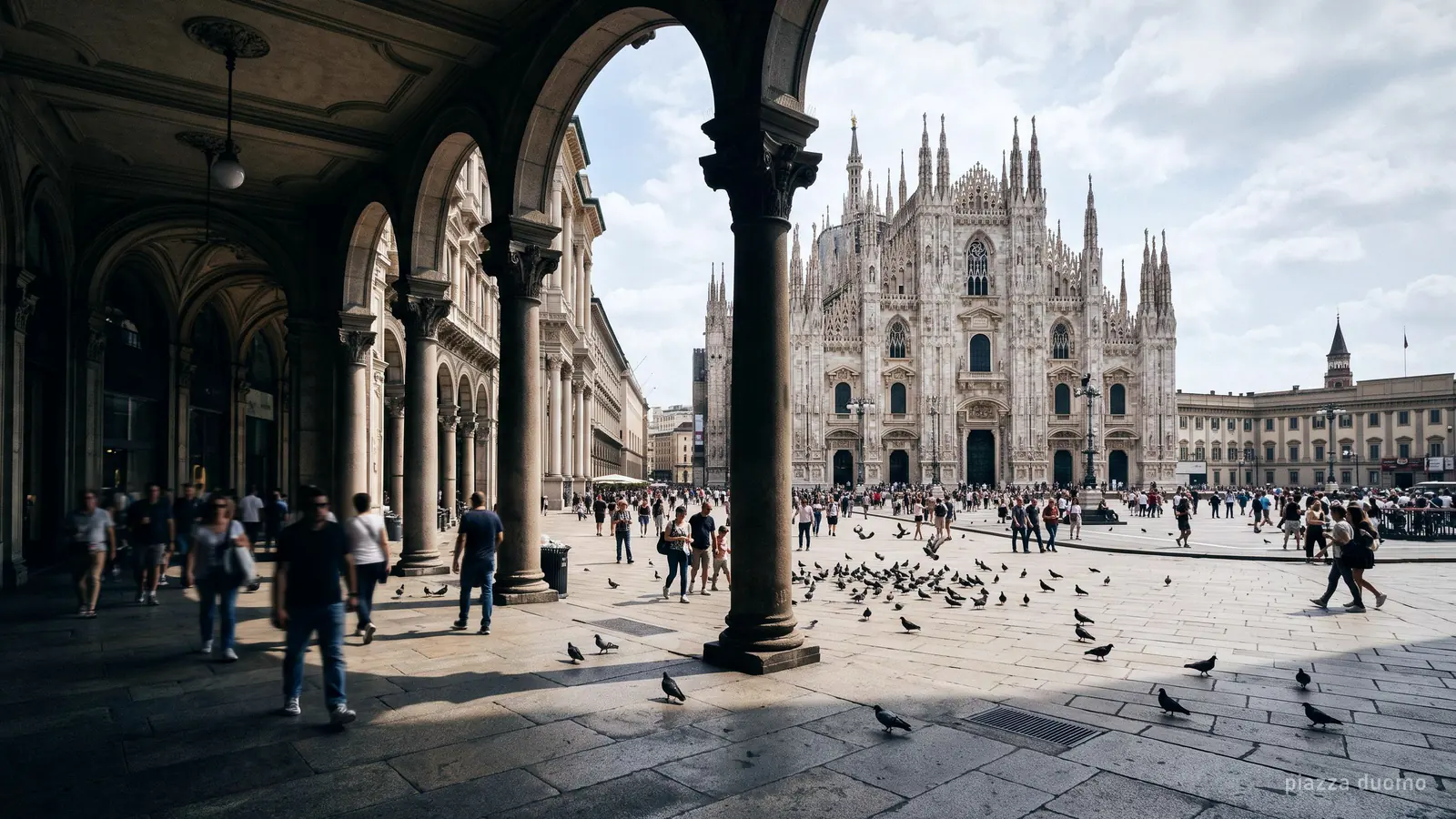
Piazza del Duomo is the centre of Milan in every sense: the point the metro lines meet, the address the city measures itself from, and a rectangle of about 17,000 square metres with the cathedral filling one end of it. Almost everything around it went up in a single burst of 19th-century planning, which is why a medieval church stands in a square that looks Victorian. It is free, open at all hours, and busy from breakfast until long after the cathedral has closed.
What stands on the square
The cathedral takes the east end. On the north side, the triumphal arch of the Galleria Vittorio Emanuele II leads through to La Scala; the arcaded blocks either side, the Palazzi dei Portici, were completed in 1875 and now hold cafes, shops and the department store with the terrace facing the facade. On the south side stands the Palazzo Reale, designed by Giuseppe Piermarini in the late 18th century, which houses the Duomo Museum at number 12 and the city's big temporary exhibitions. Beside it the Arengario, built under Fascism, now holds the Museo del Novecento, opened on 6 December 2010, whose top floor looks straight back at the cathedral. In the middle, the equestrian statue of Victor Emmanuel II, inaugurated in 1896, is the meeting point everyone uses.
- Duomo di Milano — The cathedral itself, with the ticketed visitor entrance on the right of the facade and the free worshippers' door on the left.
- Galleria Vittorio Emanuele II — Mengoni's glass-roofed arcade of 1865 to 1877, free and open at all hours, leading north to Piazza della Scala.
- Palazzo Reale — Piermarini's royal palace, home to the Duomo Museum at Piazza del Duomo 12 and to major exhibitions.
- Museo del Novecento — Futurism, Boccioni and Fontana in the Arengario, with the best elevated window onto the facade.
- Monument to Victor Emmanuel II — The 1896 equestrian statue in the centre of the square, and the city's default meeting point.
- The Portici arcades — The colonnaded blocks of 1875 on the north and south sides, with cafes, the tourist office and the department store.
How the square came to look like this
It did not grow; it was cleared. After the Second Italian War of Independence the city held a competition to redesign the space in front of the cathedral, and Giuseppe Mengoni won it. Between 1865 and 1873 the piazza was enlarged and rebuilt to his plan, medieval blocks were demolished, and the Galleria was cut through to link the cathedral with the opera house. Mengoni did not see it finished: he fell from scaffolding on the Galleria shortly before its inauguration. Later Milan kept editing the square, most visibly by stripping the advertising hoardings that once covered the facades. What you see is a single 19th-century composition with one 14th-century building in it.
What happens here
The square is Milan's stage. The Christmas tree stands in front of the facade each December, lit in a public ceremony at the start of the month; in 2025 the Milano Cortina Games tree was lit on 6 December at 18:00, and the 2026 ceremony is announced by the city each autumn. The Christmas market fills the piazza with wooden stalls from around the start of December to Epiphany, with the exact dates announced by the city each autumn. Concerts, sports celebrations, political rallies and the city's New Year all happen here, and the Arengario is scheduled to host the closing ceremony of the 2026 Winter Paralympics. On feast days, especially Sant'Ambrogio on 7 December, the square belongs to the cathedral rather than to tourism.
Where to sit, eat and photograph
Sitting on the square costs money and the coffee is not the reason to do it; the reason is the view. The historic cafes under the arcades and inside the Galleria charge accordingly, and the two commercial rooftop terraces on and beside the square, rated 3.6 and 3.3 on Google from 5,810 and 3,505 reviews, sell an angle rather than a kitchen. The better-value elevated options are the department store's top-floor food hall and the Museo del Novecento's cafe, both facing the facade. For photographs, shoot from under the north arcades for a framed foreground, from the centre by the statue for the whole front, and from the south-east corner for the flank with its buttresses in perspective.
Getting there, and staying comfortable
The metro station under the square is Duomo, served by both M1 (red) and M3 (yellow), on a €2.20 ticket valid 90 minutes. Trams stop on the edges of the piazza and taxis cannot enter it. The square is inside Milan's restricted traffic zone, so arriving by car is a paid and pointless exercise. It is well lit, heavily policed and busy late, and the real nuisances are pickpockets in the crowd near the Galleria entrance and men pressing friendship bracelets or bird seed on anyone who stops. Keep the bag closed, keep walking, and do not stand still in the middle of the square with a phone held out.
Museo del NovecentoPalazzo Reale exhibitionsComune di Milano events
Frequently asked questions
Is Piazza del Duomo free to visit?
Yes. The square is open public space at all hours with no ticket. Only the cathedral, its terraces, the museums and the archaeological area under the square are paid.
How big is Piazza del Duomo?
About 17,000 square metres, rectangular, laid out to Giuseppe Mengoni's design between 1865 and 1873 by demolishing the medieval blocks that stood in front of the cathedral.
What is the building next to the Duomo?
Several. The Galleria Vittorio Emanuele II is the arcade to the north, the Palazzo Reale with the Duomo Museum is to the south, and the Arengario beside it holds the Museo del Novecento.
Is the square safe?
Yes, with normal city sense. It is lit and policed at all hours; the problems people report are pickpocketing and pushy sellers rather than danger. Keep bags closed and decline anything offered to you.
What is the statue in the middle?
King Victor Emmanuel II on horseback, inaugurated in 1896. It is the standard meeting point on the square and the best position for a photograph of the whole facade.
When is the Christmas market on the square?
Roughly from the start of December to Epiphany, with the tree lit in an evening ceremony in the first week; sources disagree on the exact dates each year, so check the city's announcement before travelling.
Sources