
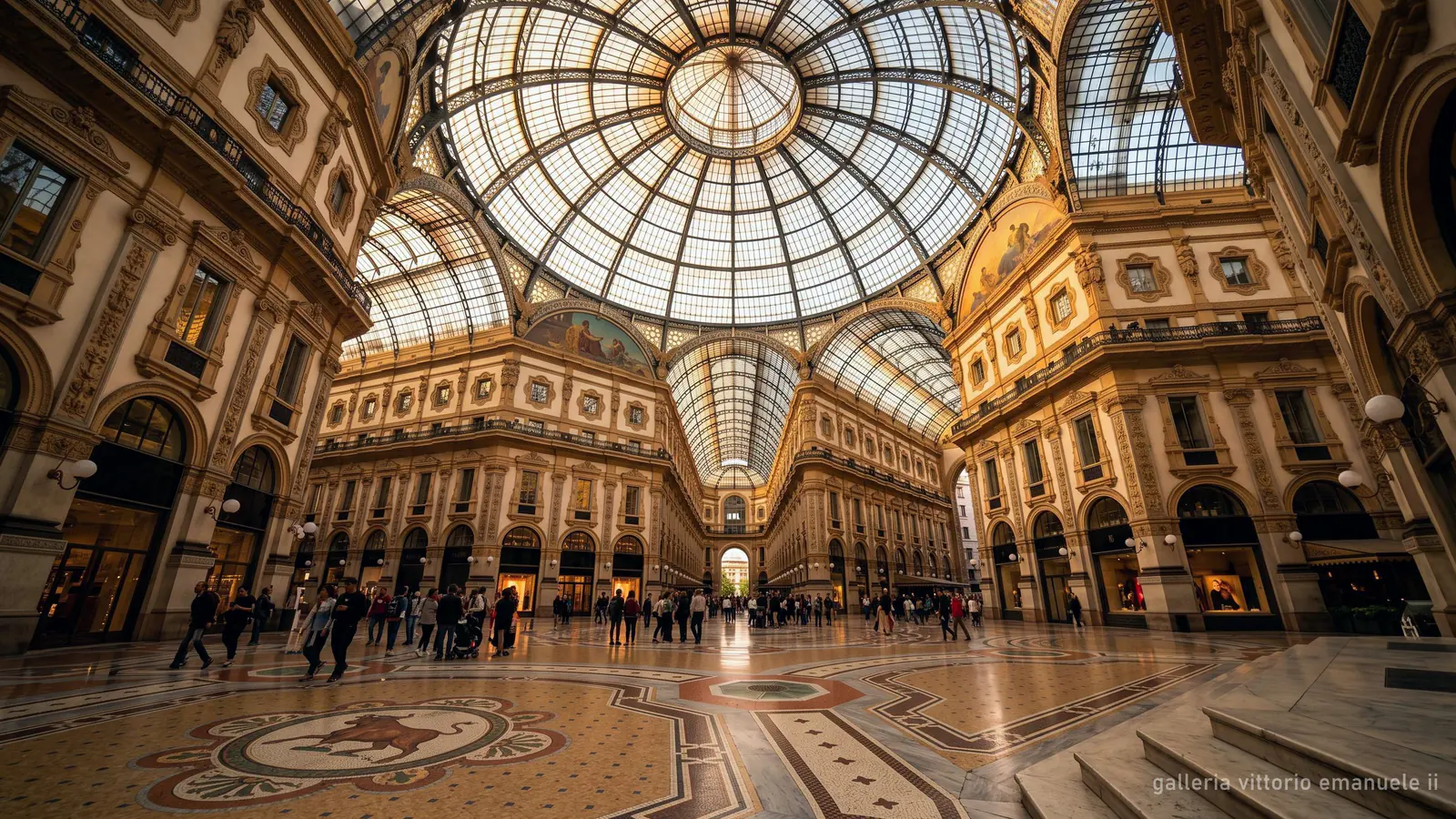
Galleria Vittorio Emanuele II, Milan
Updated September 8, 2026
The Galleria Vittorio Emanuele II is the glass-roofed arcade that runs from Piazza del Duomo to Piazza della Scala, built between 1865 and 1877 to Giuseppe Mengoni's design and generally called the oldest active shopping arcade in Italy. It is a public street rather than a mall: no ticket, no gate, no closing time. Milanese call it il salotto di Milano, the city's drawing room, and on Google it holds 4.7 out of 5 from about 112,300 reviews, second only to the cathedral itself among the things on this square.
What it is and why it is famous
Mengoni designed it in 1861 and it was built from 1865 to 1877 as part of the same programme that cleared and rebuilt Piazza del Duomo. Two glass-vaulted arms cross in a central octagon under a dome about 37.5 metres across, and the whole structure is iron and glass over stone, an industrial building dressed as a palace. It was a statement about the new Kingdom of Italy as much as a shopping street, which is why it is named after the first king and why the mosaics on the floor carry the arms of the kingdom's capitals. Mengoni fell from the scaffolding and died shortly before the inauguration, a fact every guide repeats and the building does not commemorate.
The bull, and the ritual
In the central octagon, four mosaics show the coats of arms of Turin, Florence, Rome and Milan. Turin's is a bull, and the tradition is to place your heel on the bull's genitals and spin three times for good luck. Enough people have done it that a hole has worn through the mosaic at that exact spot, repaired in 2017 and again in 2026. It is the single most photographed floor in Italy and there is usually a short informal queue. Whether it brings luck is not this site's department; that it damages a 19th-century mosaic is documented, and the repairs are on the record.
Shops, cafes and restaurants inside
The Galleria mixes fashion houses with businesses that have been here since the beginning. Biffi Caffe dates from 1867, the hatter Borsalino opened a shop in 1883, and Savini and Camparino are part of the same continuity. Alongside them are the flagship boutiques that make this one of the most expensive retail addresses in Europe. Prices reflect the address in every category: a coffee taken sitting down under the glass costs several times what it costs standing at a bar one street away, and the terrace bar at the Duomo end trades on its view rather than its cooking, at 3.6 on Google from 5,810 reviews. Look up rather than in the windows: the lunettes, the frescoes and the ironwork are the reason to be here.
- Biffi Caffe — Founded 1867, one of the original tenants and still a cafe on the arcade.
- Borsalino — The Alessandria hatter, in the Galleria since 1883.
- Savini — The historic restaurant on the octagon, long associated with La Scala audiences.
- Camparino in Galleria — The bar at the Duomo end where the Campari family business began.
- Luxury flagships — Fashion and jewellery houses occupy most of the remaining frontage at some of Europe's highest retail rents.
The ten-minute walk from the Duomo to La Scala
Enter through the triumphal arch on the north side of Piazza del Duomo, walk to the octagon, spin on the bull if you must, then continue straight out of the far end into Piazza della Scala. That puts you in front of the opera house, inaugurated on 3 August 1778 to Giuseppe Piermarini's design, with the Museo Teatrale alla Scala in its foyer and 2,030 seats behind the facade. The whole walk takes about ten minutes with stops. Done in the other direction it is the best approach to the cathedral in the city, because the facade appears suddenly through the arch rather than gradually.
Practical notes
The Galleria is a covered public street: free, always open, and passable at three in the morning, though the shops keep normal Milanese hours and the restaurants run late. It is the driest route across the centre in October, the wettest month, and the coolest in August. It is also where pickpockets work the Duomo crowd, so keep bags closed at the arch, which is the busiest pinch point. There are no toilets; the department store and the cafes are the answer. Photographs work best from the octagon looking up into the dome, or from inside looking out through the arch at the cathedral.
Teatro alla ScalaComune di Milano, Galleria
Frequently asked questions
Is the Galleria Vittorio Emanuele II free?
Yes. It is a public covered street with no ticket and no gate, open at all hours, though the shops and restaurants inside keep their own times.
Why do people spin on the bull?
The mosaic bull is Turin's coat of arms, and the tradition is to spin three times on it with a heel for luck. The practice has worn a hole in the floor, repaired in 2017 and again in 2026.
How old is the Galleria?
Designed in 1861 and built between 1865 and 1877 to Giuseppe Mengoni's plan. It is usually described as the oldest active shopping arcade in Italy.
What is inside the Galleria?
Luxury fashion flagships alongside businesses that predate them: Biffi Caffe from 1867, Borsalino from 1883, Savini and Camparino, plus restaurants and a rooftop terrace bar at the Duomo end.
How long does it take to walk through?
About five minutes end to end, or ten with stops. It links Piazza del Duomo to Piazza della Scala and the opera house, which is the standard route between the two.
Is it worth eating there?
For the setting, yes; for value, no. Prices reflect one of Europe's most expensive retail addresses, and the terrace bar at the Duomo end scores 3.6 on Google across 5,810 reviews.
Sources